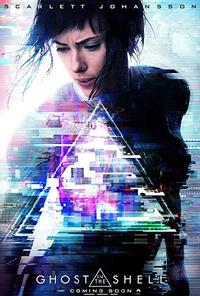
GHOST IN THE SHELL (1995)(aka: Kôkaku Kidôtai)recommended! Dir: Mamoru Oshi (PATLABOR 1 & 2, STRAY DOGS, AVALON)
Based on the popular manga by Masamune Shirow, director Mamoru Oshii took on the task of bringing this high-concept narrative to the big screen as a multi-media anime. Heralded as the biggest anime breakthrough since AKIRA and the pinnacle of cyberpunk, GHOST IN THE SHELL spawned sequels, a long running video game series and recently was bought by Steven Spielberg for a 3-D Hollywood remake.
In a near future megalopolis, where the internet "network" is everything, the real world and all it's citizens have a mirrored presence online. A persons "ghost" has every bit as much sophistication and personality as their real, physical existence or "shell." The question becomes: if our real selves have a soul, does not our ghost have the same soul? When a hacker entity known as "Puppet Master" starts jumping international boundaries on the network, authorities track it to Asia where local police in "Sector Nine" get involved, including a cyborg assassin named Major Motoko Kusanagi. Motoko has all the qualities of a real person, yet she senses a missing part to herself and often contemplates her own birth/death by immersion in a sensory deprivation chamber. Her partner on the force is a human who has been "upgraded" with cybernetic parts. This is an age where the difference between man and machine is beginning to blur and the moral underpinnings of "what makes an individual exist" are evolving as well. When Puppet Master is finally cornered, "he" inhabits an incomplete cyborg body in a factory and immediately claims "sanctuary" under Sector Nine's neutrality status. The authorities argue he cannot because he is an "entity", not a person, and the legality depends on the jurisdiction of where his true human "shell" resides. It is at this point that Puppet Master reveals that he has no human host and exists only as a ghost, born of the network.
This has never happened before, but Puppet Master insists he is a "sentient being" with a soullike any other. When one of the officials asks him to "prove it" he responds by saying, "prove that YOU exist." In the end, the only resolution for both Motoko's unquenched spirituality and Puppet Master's corporeal existence, is that the two interface online and "merge" their ghosts into one new and unique entity- part cyborg ghost and part network. Downloaded into a new human shell, the new identity stands overlooking the city and whispers, "such a vast network- where will the newborn go?"
GHOST IN THE SHELL clearly owes it's biggest influence to BLADE RUNNER, but i was especially reminded of the spiritual existentialism of SOLARIS. Although it has all the trappings we've come to know from Asian anime- the high-tech action, the weaponry, the naked robot chicks, etc. - i found the film to be an in-depth meditation on futurism. Unlike other more dystopic cyberpunk stories, GHOST IN THE SHELL leaves us with an optimistic concept of an evolving human consciousness. Although a bit clunky in the first act and filled with long-winded exposition, director Oshii combines a difficult palette of hand drawn animation, digitized animation and native computer graphics; into a seamless visual narrative of ever transitioning points-of-view. Criticized by some anime fans as being slow-paced, GHOST IN THE SHELL's conceptual matter offered a quantum leap in high-concept science fiction. As our digital revolution moves relentlessly forward, concerns about our own identity is a theme constantly echoed in sci-fi culture. The more recent THE ISLAND and AEON FLUX use thematic premises about ownership of identity, but none go as in depth as GHOST IN THE SHELL did over a decade ago.
GHOST IN THE SHELL (2017) Dir: Rupert Sanders (SNOW WHITE AND THE HUNTSMAN)
Review coming soon!
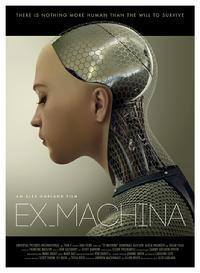
EX MACHINA (2015)recommended! Dir: Alex Garland (Writer of: 28 DAYS LATER, SUNSHINE, DREDD and THE BEACH)
Fantastic indy sci-fi about Articial Intelligence reaching the "Singularity" (self-aware sentience.) Not a horror film, but certainly unsettling and filled with a host of horrific moments. EX MACHINA follows in the lineage of Dean Koontz' PROTEUS aka: DEMON SEED (see review), Philip K. Dick/Ridley Scott's BLADRUNNER, James Cameron's THE TERMINATOR, Mamoru Oshii's GHOST IN THE SHELL (see review), Kubrick/Spielberg's A.I., The Sci-Fi Channel's: BATTLESTAR GALACTICA and especially Stanislaw Lem's SOLARIS (specifically, the 2002 Steven Soderberg remake of the 1972 Andrei Tarkovsky classic.)
...and by the way, it's pronounced: Ecks Mawk-ee-naw
Full review coiming soon...
GHOST IN THE SHELL (1995) / EX MACHINA (2015)
GHOST IN THE SHELL (1995) / EX MACHINA (2015)
"Such a vast network- where shall the newborn go?"
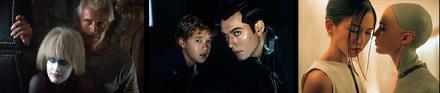
BLADERUNNER (1982) / A.I. (2001) / EX MACHINA (2015)
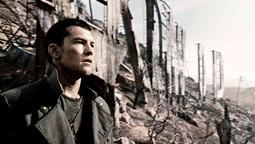
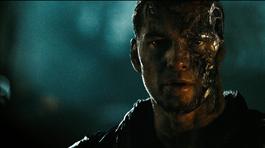
GHOST IN THE SHELL (1995) / TERMINATOR:SALVATION (2009) / EX MACHINA (2015)
Modern Prometheus...
BLADERUNNER (1983) / A.I. (2001) / EX MACHINA (2015)
BLADERUNNER (1983) / A.I. (2001) / EX MACHINA (2015)
"Fiery the angels rose..." Birth of the new proletariat under-class
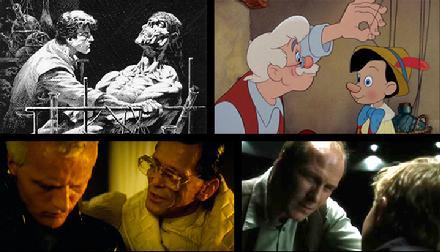
Playing God: Creation imitating Life, imitating Creation...
BATTLESTAR:GALACTICA (2003)
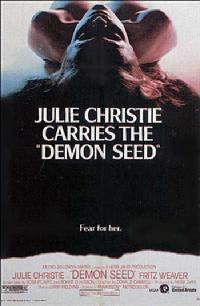
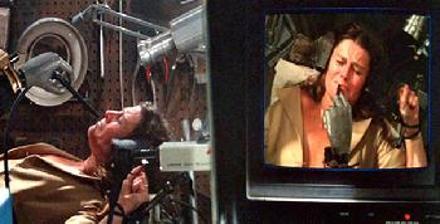
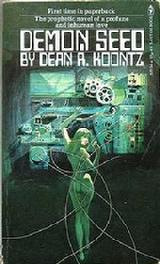
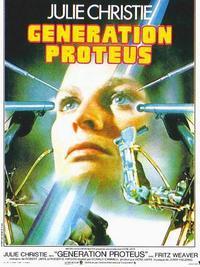
DEMON SEED (1977)recommended! Dir: Donal Cammell (PERFORMANCE, WHITE OF THE EYE, WILD SIDE)
Before HARDWARE, BRAINSTORM, THE TERMINATOR, BLADERUNNER and before A.I., there was DEMON SEED. Based on the novel by Dean Koontz. Feeling like a mixture of Michael Crichton and David Cronenberg, this cautionary tale about man-made artificial-intelligence avoids any would be cheese-ball action in favor of heavy conceptual content. Great performances by Julie Christy and Fritz Weaver. Thoughtful and engaging screenplay by Robert Jaffe and Roger O. Hirson.
Full review coming soon!
If we could put all of human knowledge into a single, artificial intelligence, what would it want to say? What would it want to do? What would it want to be?
PROTEUS IV: "I want to study man: his isometric body and his glass-jaw mind."
DR. HARRIS: "Ambitious program, but at the moment all the terminals are occupied."
PROTEUS IV:"Construct one."
DR. HARRIS: "I'm sorry. Request denied."
PROTEUS IV:"Dr. Harris, when are you going to let me out of this box?"
BLADE RUNNER 2049 (2017)recommended! Dir: Denis Villeneuve (ARRIVAL (see review), SICARIO) One of the most immersive cinematic experiences I've ever witnessed. The film took its time, which was both its greatest asset and biggest deficit. It is rare to witness a film that loses itself in itself and does not pander to time constraints or expectations. Perhaps an acquired taste, but for me, watching this film was pure joy. Also, as with its predecessor, the film is an important moment in our cultural regards to Articifial Intelligence and at once, honors other works in A.I. Cinema, even as it marks a new milestone in such lineage.
Although considered Science-Fiction, we must consider the horror elements contained within, certainly in the lineage of Mary Wollstonecraft Shelley's FRANKENSTEIN which is heralded as a masterwork progenator of both Sci-Fi and Horror.
To anyone familiar with the history of A.I. commentary in Cinema, titles such as the recent EX MACHINA (see review), GHOST IN THE SHELL (see review), TERMINATOR, A.I., DEMON SEED (see review), I ROBOT, SURROGATES, WESTWORLD (see below), COLOSSUS: THE FORBIN PROJECT (see review), The SciFi Channel's BATTLESTAR GALACTICA and of course BLADERUNNER (1981); will be up to speed with the concepts in BLADERUNNER 2049. Continuing the themes these other sci-fi works have established, this new film ups the cyber-punk anty for a current generation.
(I will need to write an entire essay on this film at a later date...)
Human likenesses searching to understand their own desires to be Human in BLADERUNNER:2049
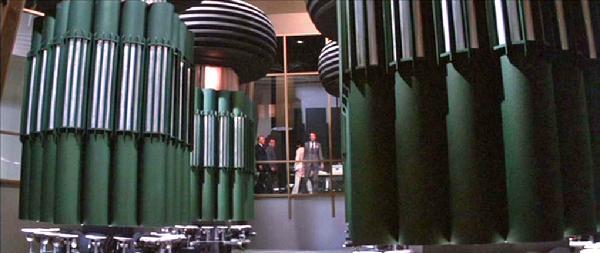
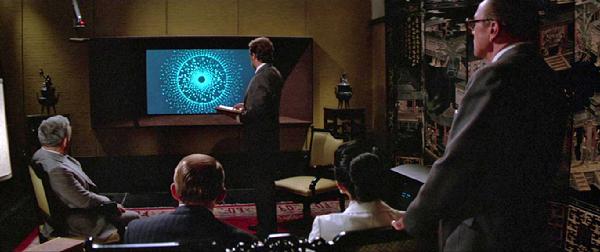
COLOSSUS: THE FORBIN PROJECT (1970) recommended! Dir: Joseph Sargant Eric Braeden ("Victor" from TV's The Young and the Restless, sans moustache) stars in this sci-fi/horror tale about man's Faustian bargain with a computer that becomes God. This one has kicked around on YouTube forever and I had known about it but never seen. A "Google-Talks" interview with Bill Nye reminded me of the film when Nye reflected on sci-fi movies that might possibly be prophetic. Although Nye made light of the film, I was really taken by it. Solid acting, direction and production design make for a compelling cautionary tale of scientific hubris and finding Hell via all our best intentions. Equal parts cold-war tension (FAILSAFE, SEVEN DAYS IN MAY, THE MANCHURIAN CANDIDATE, WAR GAMES) and high-concept sci-fi (DEMON SEED, TERMINATOR, BATTLESTAR:GALACTICA, EX MACHINA) COLOSSUS does what stories of its' kind do best- act as a popular meme that expresses an entirely broad concept in one single title or phrase.
A recent discussion between Astrophysicist Neil DeGrasse Tyson and Neuro-Scientist Sam Harris on artificial intelligence brought me back to COLOSSUS once again. As the two scholars waxed philosophic about the possibility of a self-determining AGI (Artificial General Intelligence) capable of adjusting its own source code, I found they were practically reading straight from the COLOSSUS script. In follow up discussions, Harris actually used the term "Colossus" to reference such potential, out-of-control "AGI." This reminds me how sci-fi films are not just pieces of entertainment, but high-concept thought experiments that can act as informational and cautionary tales. Whether prophetic or not, COLOSSUS was way ahead of its time and not only smart science-fiction, but also an eerily haunting horror tale.
Screenplay by James Bridges (THE PAPER CHASE, THE CHINA SYNDROME, URBAN COWBOY) and based on the novel by D.F. Jones.
HER (2013)recommended! Dir: Spike Jonze (ADAPTATION, BEING JOHN MALKOVICH)
Another fantastic entry in "A.I. Cinema" that follows in the footsteps of GHOST IN THE SHELL, EX MACHINA, BLADE RUNNER 2019, DEMON SEED and others.
Full review coming soon!
TRANSCENDENCE (2014) recommended!
Dir: Wally Pfister
Perhaps the best of all the A.I. films because it incorporates just about all the popular A.I. themes into one narrative.
ALITA: BATTLE ANGEL Dir: RObert Rodriguez (GRINDHOUSE: PLANET TERROR, SIN CITY, SPY KIDS) Review coming soon!
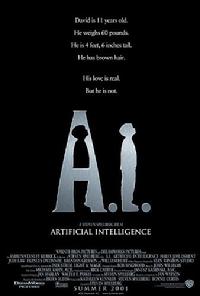
A.I.: ARTIFICIAL INTELLIGENCE (2001) recommended! Dir: Steven Spielberg Man's existential hell cannot help but be visited upon all that he makes in his own image. Produced and conceived by Stanley Kubrick with direction by Steven Spielberg at Kubrick's request. Powerful 1st and 3rd acts (with a sagging 2nd act) make for a powerful Promethean/Sisyphusian tragedy. A conscious entity searches for its' creator, only to find that it is ultimately on its' own without the very answers it has been designed to seek.
Full review coming soon!
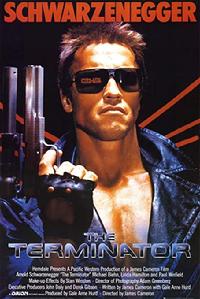
THE TERMINATOR (1984) recommended! Dir: James Cameron Set the bar for dystopic, cyber-punk, time-travel, evil robot A.I., apocalyptic, end-of-the-world, hyper-action! Fusing Sci-fi, Action and Horror genres and taking all to a new adrenalized level in pop cinema. The concepts were fresh enough to be unique at the time and have entered ideas and terms into our common lexicon like: "Cyborgs," "Future War" and "SkyNet." This film launched Arnold Schwarzenegger's film career into the stratosphere. Stan Winston Studios were employed for practical make-up effects and Cameron's choice of rear-screen projection and miniatures animation was used to full effect in the "Future War" flashback scenes. The soundtrack by Brad Feidel, which used many real world sampled sounds in its computerized score, is credited as being the father of the "industrial" genre of electronic music. Loosely based on (if not entirely plagerized from) an episode of TV's The Outer Limits called "Soldier From The Future" written by Science Fiction stalwart Harlan Ellison.
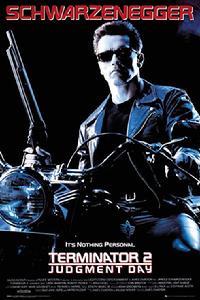
TERMINATOR 2: JUDGMENT DAY (1991) recommended! Dir: James Cameron Continues the concepts and storyline of the first film, but introduces time-shifting twists (ex: the future is "not set") as well as themes of what control mankind would or should actually have over the destiny of a sentient artificial intelligence. When a killer robot from the future is reprogrammed to be humane, it not only begins learning and reprogramming itself to human specifications, but also exhibits more "humanity" than some its real human comrades. In this new light, what exactly is "humanity" anyway? T2 continues and even surpasses the intense action and big-budget effects of the first film. T2 was also the first film to incorporate full on CGI digital animation into the main storyline with the introduction of a cyborg made of liquid metal that mimics the shape and appearance of objects it touches. Prior to this film, Cameron's earlier THE ABYSS (1989) had one scene with a CGI effect, but it was T2 that exploded CGI tech into what would become standard in special effects.
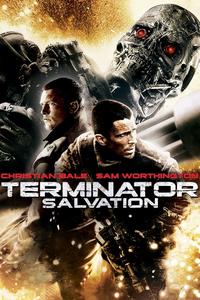
TERMINATOR: SALVATION (2009) Dir: McG What happens when a self-conscious A.I. discovers the nature of its' design? If "Free Will" is designed into an artificial intelligence in order to optimize its' potential, can that free will break free from its' programmed purpose and be a free acting individual?
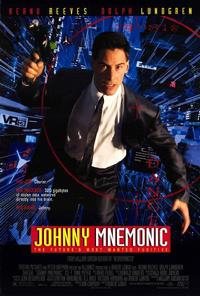
JOHNNY MNEMONIC (1995) Dir: Robert Longo The first film based on a William (Godfather-of-Cyber-Punk) Gibson story.
Review coming soon!
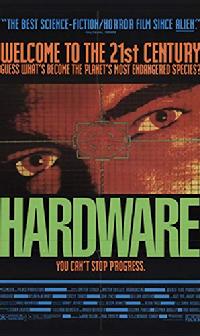
HARDWARE (1990) Dir: RIchard Stanley (THE COLOR OUT OF SPACE) Considered one of the earliest cyber-punk films, HARDWARE is certainly an A.I. film and ushered in a new straight-to-video wave of trippy, low-budget films that banked on their high-concepts rather than their production value. Think DEMON SEED meets Roger Corman!
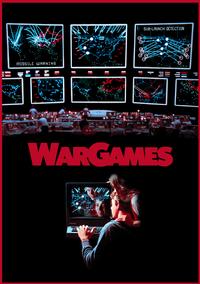
WARGAMES (1993) recommended! Dir: John Badham (BLUE THUNDER, SHORT CIRCUIT, SATURDAY NIGHT FEVER) Review coiming soon!
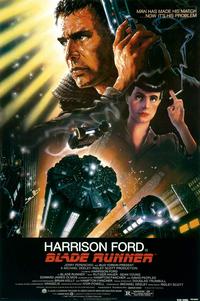
BLADE RUNNER (1982) recommended! Dir: Ridley Scott The benchmark for "cyber-punk" and "A.I." cinema.
Full review coming soon!
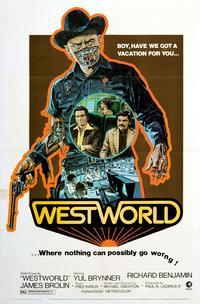
WESTWORLD (1973) Dir: Michael Crichton (COMA, LOOKER, RUNAWAY) High-Concept and influential sci-fi drama about a near future where replicant androids populate an adult playground-for-the-rich resort. Since the robots are not actually human, the guests can treat them however they like regardless of any standard moral regard. This of course opens a Pandora's Box of ethical conundrums. Yul Brenner portrays a strong and silent gunslinger in WESTWORLD, a habitat where guests can enact real-life Cowboy shoot-outs without risk of actual injury- that is until he begins shooting back for real! This film gave rise to the recent Netflix original series of the same name.
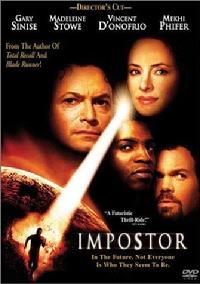
IMPOSTER (2001) Dir: Gary Fleder Adapted from the Philip K. Dick short story.
Review coming soon!
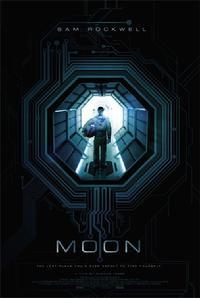
MOON (2009)recommended! Dir: Duncan Jones
As the only actor in the film, Sam Rockwell does a fantastic job holding this entire film by himself. Certainly influenced by Kubrick's famed 2001: A SPACE ODYSSEY, MOON deals with concepts of isolation, sanity and identity.
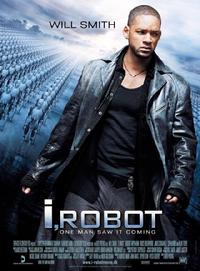
I, ROBOT (2004) Dir: Alex Proyas (THE CROW, DARK CITY)
Based on the landmark book "I, ROBOT" by Isaac Asimov which set the standard for all discussions on artificial intelligence and introduced Asimov's "Three Laws of Robotics" which have been followed not only in literature and cinema, but even in real life engineering. Sadly, this film plays more as an action flick than the anthology of thought-experiments / cautionary-tales that made up Asimov's classic. In spite of the great production design and CGI tech, plays out like a very predictable movie-of-the-week about the big bad corporation up to no good. Yawn.
RELATED TO "A.I. CINEMA"
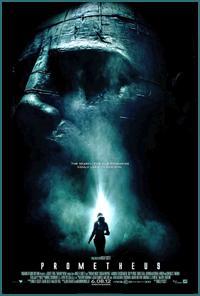
PROMETHEUS (2012)recommended! Dir: Ridley Scott (ALIEN, BLADERUNNER, THELMA & LOUISE, GLADIATOR, BLACK HAWK DOWN)
Man searches for God - Man finds God - God punches man in the face...
Ongoing scientific and theological debates over theories of our human origins have reached a critical mass in our popular discourse of late, and this film is right on top of it. 2001: A SPACE ODYSSEY meets Greek tragedy in this mythological epic about man's search for meaning.Unfortunately, terrific high-concept ideas and a great first act set-up ultimately are betrayed by very basic oversights on the surface level of the plot and characters.
In one of the greatest cinematic opening sequences in recent memory, a primordial Earth is impregnated by an alien "Engineer" who sacrifices itself - mixing its own DNA into the eco-system. These alien creators of mankind leave clues of their visit behind, and when we are advanced enough, we set out in search of them. The cold and detached Captain Vickers (Charlize Theron) commands the deep space explorer "Prometheus" and is frankly much too good for her simple role here. The show is stolen by "Dave" (Michael Fassbender), a cyborg who (shock/surprise) is more human than the human characters. The mission is undone by Larry, Daryl & Daryl - the working stiffs of the ships crew who, despite their status as scientists, act more like the ignorant teens of a slasher film. Vickers lives in the shadow of her mad scientist "Captain Ahab" father - a man sustained by artificial life support, clinging to his mortal existence just long enough to find the answers he seeks no matter the cost. His only relationship with his daughter is a business one, as they are joined via his corporation which she works for as an executive. How can man connect with his Creator/Father if he can't even connect with his own human family?
Man's hubris spites itself as we get to meet our creators, only to realize we are merely leftover cells in a Petri dish to them. Yes, as it turns out, we are made in their image. Scott inverts the man-meets-God scene from his BLADERUNNER here- this time with man meeting his engineer. The replicant "Dave," a facsimile made in our image, is the first to approach and is decapitated (only he survives and later helps complete the mission). There is a wonderful closing shot as a spacecraft exits the atmosphere of the planet to search for the origin of the "Engineers." Man's quest for answers continues on, the ship's after-burners slicing across the sky reminiscent of Nimrod's arrow in the book of Genesis, Icarus' doomed flight near the sun, or (of course) Prometheus flying in the face of Zeus. The film leaves off at the birth of the alien xenomorph creature from the other ALIEN films, thus tying this in as a prequel.
Compelling as is, but oh what a film this could have been...
THE MATRIX (1999) Dir: The Wachowski Brothers
Review coming soon!
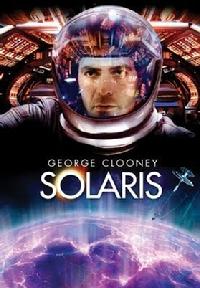
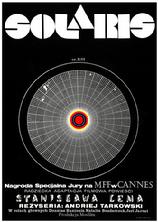
SOLARIS (2002) recommended! Dir: Steven Soderbergh
Remake of the Andre Tarkovsky classic, based on the book by Stanislaw Lem.
Review coming soon!
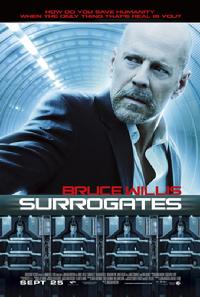
SURROGATES Dir: Jonathan Mostow (TERMINATOR3: RISE OF THE MACHINES, U-571, BREAKDOWN)
Review coming soon!
LUCY (2014) Dir: Luc Besson (THE FIFTH ELEMENT, LA FEMME NIKITA, LEON: THE PROFESSIONAL) Scarlett Johannsen stars in this sci-fi/actioner about a girl who is given a chemical that allows her brain to use 100% of itself, rather than the standard 10% of normal humans. The girl evolves beyond the scope of modern man into a sort of super-hero, and eventually into pure energy while a group of scientists (Morgan Freeman) race to learn all they can from her before she transcends corporeal form. I appreciated that, while bordering on a super-hero origin story, the film chose not to go that route, instead focusing on the high-concept science and the plot tension. Very slick production and effects as one would expect from Besson. Johanssen is solid as she continues her fascination with high-concept sci-fi projects (GHOST IN THE SHELL(2017), UNDER THE SKIN (2013) (here) )
UNDER THE SKIN (2013) Dir: Jonathan Glazer (SEXY BEAST) Glazer is the kind of director who takes an idea and just meditates on it, with little story. UNDER THE SKIN follows the exploits of an alien creature (Scarlett Johansson) in human female form, who hitch-hikes around Scotland luring men to their deaths. With promises of sexual fulfillment, the alien girl brings the men to an abandoned building where, hypnotized, they wade into some bizarre liquid until over their heads. Once immersed in the dark goo, the men freeze in an unemotional stasis, eventually just sort of disintegrating into frozen shards of paper. Later, the goo is flushed out a drainage pipe like yesterday's business. It seems that our alien protagonist has gone off reservation because a team of other male looking aliens begin tracking her down. Heading out of the city and into the country, alien girl takes up with a man and seems to begin a love relationship. However, when in the bedroom he enters her in lovemaking, she recoils in shock, inadvertently killing the man. With no care whatsoever about her murdered lover, she examines herself in a mirror, now fully aware of the nature of her corporeal human self. Back out on the road, alien girl is raped in the woods by a logger and in the struggle, has half her body skin ripped off, revealing a black, featureless form beneath. The man runs in horror and alien girl, her inner self now exposed, crawls away. In a clearing, alien girl is confronted again by the man, who lights her on fire and burns her to death. The end.
Something is clearly going on here about the rift between genders and by putting us in the point of view of an alien, Glazer has us meditate on the masculine humanity of the hapless male victims. It is not clear if the weird plasma goo liberates the men from Earthly form or is just their pure destruction. Is this a means of transcendence? Acquisition?? Assimilation?? The film seems to imply that while going about their business these visiting aliens stumble upon a reality even they were not prepared for- the human essence of male versus female. So captivated by this is she that alien girl seems to disobey orders (we guess) and make an enemy of her alien compatriots. There are so many subtextural routes to take here. All is seemingly well and at a distance till the act of lovemaking "penetrates" and violates the experience. The aliens are non-descriptive and perhaps non-gendered, represented literally and figuratively by their featureless black forms "under the skin." Does this symbolize some essence in-potentia of sentient beings in a universal sense? Certainly the narrative is an intriguing foray into examining our sexual nature from the outside, but what is discovered and offered to the viewer is left undefined. Kudos to Johannson for continuing to work on high-concept science fiction films.
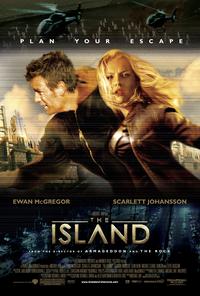
THE ISLAND (2005) Dir: Michael Bay (ARMAGEDDON, PEARL HARBOR, CON AIR, THE ROCK)
Another complete miss from Michael Bay. Awesome art direction and production design, as well as great casting, score and premise- cannot save this Hollywood assembly line misfire. Turns into a big car chase (albeit a cool one) and subverts everything it sets up in the first half. Films like this anger me because they have so much money and are right there- so close to being able to make something decent and failing every time. Bay continues to try and replace story and concept with excessive production value. It may be a fun visual ride while you watch, but seconds after it's over, you've already forgotten it. Very much a remake of LOGAN'S RUN, but without any of the substance.
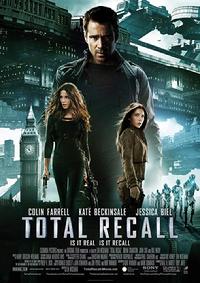
TOTAL RECALL (2012) recommended! Dir: Len Wiseman (UNDERWORLD, UNDERWORLD: EVOLUTION, LIVE FREE OR DIE HARD) Remake of the 1990 Paul Verhoeven film of the same name. Screenplay co-written by Kurt Wimmer (EQUILIBRIUM, ULTRAVIOLET). The production design and CGI effects are second-to-none, especially given that the film was shot in 3-D. Review coming soon!
RESIDENT EVIL (2002) Dir: Paul W. S. Anderson (DEATH RACE, EVENT HORIZON, SOLDIER, MORTAL KOMBAT) Review coming soon!
SOLDIER (1998) Dir: Paul W. S. Anderson (RESIDENT EVIL, DEATH RACE, EVENT HORIZON, MORTAL KOMBAT) Review coming soon!
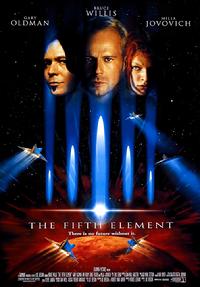
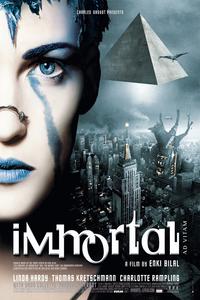
French production that was basically a re-telling of THE FIFTH ELEMENT only much more interesting. An odd and unsuccessful blend of live-action, CGI compositing and pure computer animation, IMMORTAL visually feels like several different films, yet where it fails in this autonomy, it makes up for in story and characters. The art direction and design are an exciting mix of retro and new with an overall cyberpunk aesthetic. Thankfully, the standard cliches of evil corporations, genetic viruses and post-apocalypse are refreshingly absent here. Instead, the story revolves around a god who inhabits a human in order to impregnate an alien hybrid girl and procreate a new race. High concept stuff that plays out like a blend of AKIRA, BLADE RUNNER and THE FIFTH ELEMENT. A bizarre and refreshing project with lots of heart.
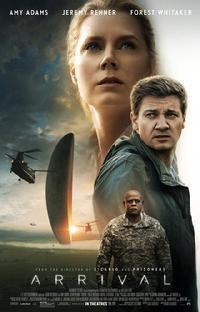
ARRIVAL (2016)recommended! Dir: Denis Villeneuve (SICARIO, ENEMY, PRISONERS, INCENDIES) Science Fiction at its best! Can't recommend highly enough!
With horror elements and intrigue, this Sci-Fi masterpiece focuses on communication and language as not only means of connection, but also possible transcendence. In the tradition of THE DAY THE EARTH STOOD STILL(1951), the arrival of extraterrestrial aliens who just sort of show up and sit there, causes humanity to go upside down. Will our fears of the unknown boil over and provoke unnecessary disaster in our moment of greatest scientific opportunity? It seems the alien ambassadors, scientists in their own right, are facing the same pressure from their leaders that the Earthlings are getting from their own. With the clock ticking toward apocalypse, the aliens sacrifice themselves in an effort to connect, an incredible act of good will, but will it be enough for the humans to get it together and seize the correct path?Terrific writing, direction, cinematography, musical score, production design and performances make this one for the ages.
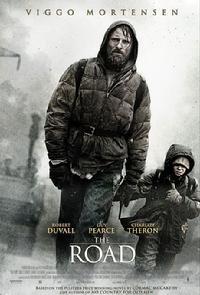
THE ROAD (2009)recommended! dir: John Hillcoat (THE PROPOSITION)
My other 'pick of the year.' Although it is perhaps, the most depressing film I've ever seen, THE ROAD is also a masterpiece. I almost ejected the DVD twice while watching it was such a downer. However, the themes in this story and their commentary on human nature are absolutely haunting. Very much a spiritual film, in the vein of I AM LEGEND (see review.) THE ROAD forces us to meditate - painfully- on what it means to be a human being- socially, personally and spiritually. The acting performances are great and there is no music, which adds to the overwhelming sense of desolation. This is a film I will be thinking about the rest of my days.
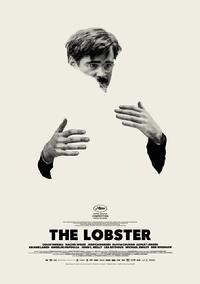
THE LOBSTER (2015)recommended! Dir: Yorgos Lanthimos (THE KILLING OF A SACRED DEER, ALPS, DOGTOOTH, KINETTA) Awesome indy absurdism starring Colin Ferrel and Rachel Weisz. In a bizarre near future, anyone who is found single is given a limited time to find a mate for marriage, or is turned into an animal (of their choice.) The film chronicles the ridiculousness we put ourselves through in order to find a partner and live up to societal expectations. Directed in a very dry, matter-of-fact style, with terrific performances.
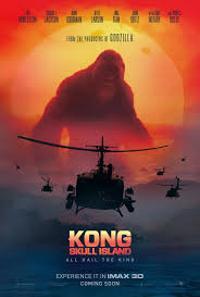
KONG: SKULL ISLAND (2017) Dir: Jordan Vogt-Roberts The CGI was really amazing in this bizarre 1970's period piece that merges KING KONG with the Japanese Kaiju tradition of giant monsters (hint, hint: GODZILLA,) South Pacific "Skull Island" has been shrouded in perpetual hurricanes since the beginning of time and evolution has developed differently here than the rest of Earth. Samuel L. Jackson plays a soldier who doesn't know how to live without a war and goes straight from Vietnam into a war against nature. Brie Larson is the obligatory hippie-chick journalist representing the anti-establishment front. Tom Hiddleston is the token beefcake who's there to be the pretty white guy. John Goodman plays a Washington Beltway beaurocrat who thinks he can find a cash-cow in the oil that likely resides under the Island. John C. Reilly is a WWII pilot who crashed down on the island and has survived with the natives ever since. The 40-story KING KONG is the guardian force of nature that acts as a moral sword to deliver justice.
The visuals are stunning and I actually liked the clever angle on the island as an evolutionary off-shoot. Unfortunately, the pacing made this feature film feel like a bit of a fly-by. I felt as though it was a three-hour film packed into two and less may have been more, whereas others have posited that this was likely the only way to pull it off. The tired Captain Ahab angle of one guy versus the monster was a bit much for me also. A post end-credits teaser ties this film to the new Warner Bros./Legendary GODZILLA franchise.
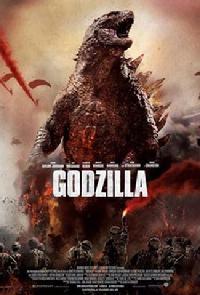
I had hoped this would be a modern re-telling/re-working of the Ishirô Honda's 1954 masterpiece GOJIRA, but instead, was a bit like a sequel. Cleverly, the writers set up a back story that both includes the original and leaves room for "the rest" of the Godzilla film legacy in a way.
I had to get over my very jaded expectations in order to enjoy what this movie has to offer, but it does have much to offer. Of particular note are the flawless special effects. The elements that must be present for any worthy Godzilla treatment are that of a giant monster straight out of the bible wreaking havoc on the present world. Somehow this monster is impervious to our weapons and technology of the day and its presence begs questions of every existential kind. I wrote about this in detail in my review of CLOVERFIELD(2008)(see review.) Well, GODZILLA has all of that in spades and for this reason alone, the movie is a highly enjoyable cinematic experience. Along with these factors there was also some interesting conceptual content that flows directly from Edward's previous film MONSTERS (see review.)Namely, questions about evolution and genetic mutation and who really is at the top of the Animal Kingdom food chain.
There were also some obvious and annoying flaws. Bryan Cranston (who I loved on TV's: "MALCOLM IN THE MIDDLE") was as over-the-top as I had feared and was an unfortunate casting choice. Thankfully, he turns out to not be the main character and is only in the films first act. My guess is he was only there for his recent award-winning popularity with HBO's BREAKING BAD series. Juliette Binoche has a brief part and is great of course, but it is clear she was a big European name brought in to pepper the project with some class. The Olsen girl was surprisingly good. David Strathairn portrays the military commander who is basically a wasted character who adds nothing. Ken Watanabe plays the scientist Serizawa- the pivotal character in Honda's original classic - but who is only a side character here, added to sprinkle in some scientific and ethical commentary.
My biggest grievance with the film is the plausibility-busting (and seriously annoying) plot line motif of having the main character present at every single major event in the storyline, even though this defies all sense of realism. One could try and argue that this is really the "past-demons" of the father and son characters playing out as monsters that flow from the point of original incident (Japan), to the home of the main character and his family (San Francisco), BUT NO, THAT'S NOT WHAT IT IS. This would have required that the monsters be created out of some act, sin, guilt or otherwise uneasy conundrum of the father or family dynamic that wills the creatures into existence. All tragedy that befalls the family is the result of the monsters being, not the other way around. Therefore, the all-too-easy plot line choice was, in my view, no metaphor but simply a cheap way to compact the already sprawling story into a concise action-drama. In doing so, this choice took the film away from the grown-ups table and placed it at the kids table. I can already hear everyone saying "but it's just a Godzilla film, what do you really expect?" SIGH...
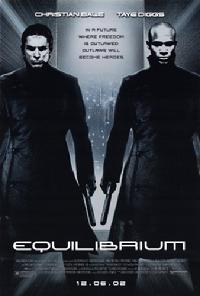
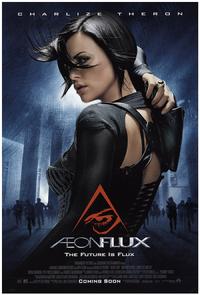
(L to R) AEON FLUX, ULTRAVIOLET, EQUILIBRIUM, THE ISLAND
EQUILIBRIUM (2002) recommended! Dir: Kurt Wimmer (ULTRAVIOLET)
Fun little straight to video CGI film with lots of martial-arts action and CGI dystopic design. Wimmer directs the action and fight scenes very well- surprisingly good and certainly much better than the big budget stuff out there these days. Similar to THE MATRIX and borrowing heavily from THX-1138 and LOGAN'S RUN; a futuristic assassin in a totalitarian dystopia changes his allegiance when his own family is targeted for termination. The premise is comic-bookish, but lots of sci-fi fun. Christian (can he choose a lousy film to star in!?) Bale (THE MACHINIST, BATMAN BEGINS) and Taye Diggs star.
ULTRAVIOLET (2006) recommended! Dir: Kurt Wimmer (EQUILIBRIUM)
Another totalitarian future with a kick-ass genetically enhanced assassin- this time played by Milla Jovovitch. A not-too-distant future Hong Kong is the setting where an evil corporate warlord wages extermination against an underground resistance force. A segment of the population has been turned into vampires as a side-effect of a corporate sponsored bio-virus that has run amok. Violet (Jovovitch) uses hi-tech weaponry to take on the humans that want to eradicate her kind. However, a new weapon- in the form of a human child- gives her second thoughts about her mission. Violet discovers things are not what they seem and must change loyalties to survive and pursue the one chance of a new viral cure. Although all of this is cliche, the action is fun and Wimmer once again pushes the limits of CGI film technology to bring Asian style anime/manga action to the screen. ULTRAVIOLET is what AEON FLUX wanted to be but wasn't, yet falls short of the cohesiveness of Wimmer's earlier EQUILIBRIUM.
AEON FLUX (2005) Dir: Karyn Kusama (GIRLFIGHT)
Yet another Hollywood misstep, Could've been good, but was big and clunky and clueless. Charlize Theron portrays an underground assassin in a future "utopia" where disease has destroyed humanity and the survivors have built a self contained city "Bregna" that is supposedly perfect. An underground resistance investigates strange disappearances and the policies of a megalomaniacal ruler who is the savior of humanity and the scientist who discovered the cure to the plague. A chance meeting clues Aeon into information that ultimately leads her to switch sides and discover the ultimate secret of Bregna and the human race. Fantastic locations, wardrobes and production design package what is essentially your average Star Trek episode. Yet another LOGAN'S RUN homage, but without the allegory to make it social commentary. Charlize Theron is surprisingly good (doing all her own stunts and fight choreography.) The martial arts are cheated with lots of editing and unnecessary camera angles. The story is lacking in essential conflict and pacing to keep it engaging. Worst of all, nothing is explained- how did Aeon become a superhero warrior? What's up with the physical mutations and "upgrades" of the other resistance fighters? The film sort of requires you to have seen the cartoon and have been a fan. I wanted to like AEON FLUX, but watching the DVD special features about the location shooting and costume design was the most interesting part.
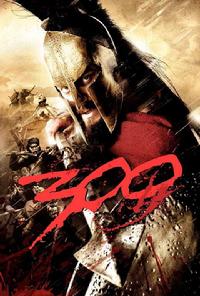
300 (2007) recommended!
Dir: Zach Snyder
Much to my surprise- a total masterpiece. Based on the graphic Novel by Frank Miller (SIN CITY). A complete auteur vision from concept to completion. Shot almost entirely against green screens in studio and composited with amazing computer graphic backgrounds. The casting is great, the action great, the score is great and the story is a myth for the ages, worthy of re-telling. This is one of those films that was so surgically precise in it's motives that it almost could not fail. Absent are all the standard marketing approaches of the Hollywood machine and the piece comes across as a passionate labor of love from Snyder and Miller. A must see!
SUNSHINE (2007) Dir: Danny Boyle (28 DAYS LATER, 28 WEEKS LATER, THE BEACH, TRAINSPOTTING, SHALLOW GRAVE)
Action/thriller from popular UK director Danny Boyle. When the world faces extinction from a dying sun, a group of scientists take a computer controlled ship with an explosive payload to restart the withering star and save human kind. When a decision that can only be made by human minds must be made, everything of course goes wrong. Like I AM LEGEND, the story offers coincidences too ironic not to contemplate the possibility of divine intervention. If, despite all our best moral and scientific efforts, our most important human mission comes down to a struggle between two individuals- one representing good and the other evil- then which is which? What is God's true will? If we face extinction- is it destined or a choice? There is Cassie, the optimist who asserts the goodness of human nature (Rose Byrne); Capa, the scientist who bases decisions on logical deduction (Cillian Murphy) and the authority figure Searle (Cliff Curtis) with his unshakeable faith in protocol. The human antagonist is an ex-ship-commander (Mark Strong) from a previous mission who, at the moment of truth, allowed himself to contemplate the nature of his task and thus gave himself over to self-absorption in the name of "meeting God." In one nicely poignant scene, an oxygen producing garden is destroyed in flames. The caretaker of the garden (Michelle Yeow) later discovers a single growing sprout amongst the ash- offering hope of survival. Again, a sense of the divine enters into the story.
Films like SUNSHINE (EVENT HORIZON, THE RED PLANET, SPHERE, MARS) are as much about set design as anything else. One almost gets the sense that filmmakers use these stories as an excuse to pay their own homage to Kubrick's 2001: A SPACE ODYSSEY. Somehow, terrific high-concepts of truth and existence always seem tomanifest into a human antagonist- usually a murderer bent on being one with God. Perhaps there is no way to boil down such existential material into a visual story-telling, but it always seems disappointing in the end. Two exceptions in the genre would be Steven Soderbergh's SOLARIS(2002) and Ridley Scott's ALIEN(1979).
Boyle directs the film with great understatement (with the exception of two moments of ridiculously unnecessary voice over) and the same dynamic visual style as previous works. There is only so much you can do with a handful of characters on a spaceship, the cinematography keeps it interesting and ever close to the existential elements of the films' premise. Constant references to light and refracted patterns off the camera lens keep us close to the idea of "light embracing us" as one character describes it. There is an ambiguous sentiment toward the sun and it's radiance- simultaneously deadly and inspiring. Is this vertigo a source of transcendence and of the divine? or is it merely a cold scientific reality? Is it our place to even know??
In this genre of characters-on-a-ship-headed-to-face-God type thing, i would place SOLARIS on one end as a complete success and EVENT HORIZON on the other end as utter failure. Given these, i would place SUNSHINE directly inbetween as a very well made "so what..?"
V FOR VENDETTA (2005)
Dir: James McTeigue
An interesting and irresolvable dichotomy of post 9/11 allegories. At what point in a society of corruption do you justify violence? In an Orwellian future of right-wing fascism, state control has used a virus against it's own people in order to look like saviors by offering the cure. It all comes down to corporate greed with politicians involved behind-the-scenes in pharmaceutical interests. When a terrorist known only as "V" starts blowing up government buildings in the name of an ancient patriot- what will become of the "will" of the people? This film from the Wachowski Brothers (THE MATRIX Trilogy) and based on the graphic novel by David Lloyd; draws reference to the events of Sept. 11, 2001 and conspiracy theories about the Bush administration possibly having a hand in the WTC bombing in order to justify a war in Iraq. In a brilliant reference, British actor William Hurt portrays the evil Big-Brother-esque ruler, who is only seen on giant TV screens (Hurt played "Winston Smith" in Michael Radford's masterpiece 1984 based on the Orwell novel.) Although story and characters are all comic-book tongue-in-cheek, the depth of the film comes in it's middle act. Evey (Natalie Portman) is captured by the state police for treason. She is tortured, put in solitary confinement and threatened with execution. Her only solace comes from secret notes from the next cell, passed through a hole in the wall. Her compatriot writes of a repressed life, doomed to persecution but how it was all worth it for the brief moments of freedom she experienced. "There's that final inch," she writes, "that last bit of you that they can never take away." These words inspire Evey and keep her sanity until she is able to face her own execution without fear. At this moment, her captor allows her to go free and reveals that he is in fact V himself! Portman does a remarkable acting performance as she confronts her friend and ally, breaking down. "You wanted to be free of fear," V explains, "now you are." Although most of the film is rather canned, the middle act offers some emotional concepts that somewhat rescues the narrative. Also, the ending stays very true to it's characters and veers away from the standard cliches one might expect. All in all, a well made film, if not rather crudely drawn in it's drama.
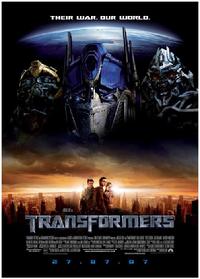
TRANSFORMERS (2007)
Dir: Michael Bay (THE ISLAND, PEARL HARBOR, ARMAGEDDON, CON AIR, THE ROCK)
1.5 out of 5 stars
Awesome special FX, retarded everything else. For the kids, else skip it. Word to the wise: if it says "Directed by Michael Bay" don't see it.
RESIDENT EVIL: EXTINCTION (2008)
Dir: Russell Mulcahy
The third in the series, this story pits Alice against yet another evil and corrupt scientist from the Lacuna Corporation. Some years after the last film, where the earth is ravaged by a virus that turns humans into zombies, the genetically enhanced warrior "Alice" (Milla Jovovitch) wanders the now desert covered North America avoiding the satellite "grid." When a convoy of survivors comes her way (direct homage to THE ROAD WARRIOR), Alice must expose herself in order to help save them from a zombie attack. The gang then decide to infiltrate Lacuna's underground hive city outside of Las Vegas and face the enemy. The film is filled with the standard Resident Evil icy laboratories with genetic mutations and Romero-esque zombie hordes roaming the desert in search of flesh. The fight scenes are well done and the special effects good enough. The film ends with a powerful new premise that will be sure to carry the franchise a few more installments. The first film was great fun, nicely produced. The second was abysmal. This new film is thankfully more of a return to the first and worth it as a B-movie rental.
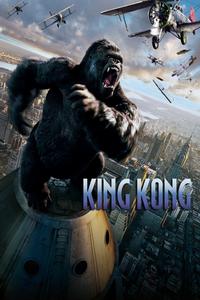
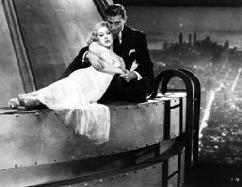
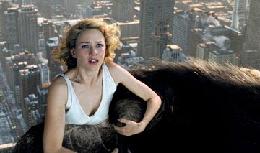
KING KONG (2006)recommended! Dir: Peter Jackson (LORD OF THE RINGS TRILOGY)
The only problem with this film is that unlike the original or the 1976 remake- the special effects are too easy and believable. The original begged your suspension of disbelief with it's stop-motion miniatures and the '76 version used more of an inferential treatment and romantic production design. Peter Jackson's opus is not as much a major leap in it's contemporary field as the others KONG's were and this remake creates a different affect within the perception process of it's audience. The epic-blockbuster hugeness associated with the previous KONG films is certainly diminished here. Aside from this unavoidable reality of modern cinema, the film is otherwise near perfection. As with his LORD OF THE RINGS trilogy, KONG has pacing problems (particularly in it's excruciatingly long first act) and may be a bit too long for it's own good at 3 full hours. If the computer generated FX are a bit too common place in this era to impact the audience they are also incredibly sophisticated and perhaps the best ever produced, eclipsing even the newer STAR WARS films in realism and detail. Though the film plays like a CGI cartoon this in no way diminishes the dramatic strength of the script. Jackson and Boyens manage to pack all the essential elements of the original story into an effective update while also taking them to much deeper levels. One of the most notable moments in the film are the two single times Ann speaks out loud to KONG, when they stare into the other-woldliness of the sunset together and she says "Beautiful." There is something truly magical in the connection of the two characters and the film places this on a pedestal. Gone is the awkward sexual overtones of the previous movies and the premise becomes much more readable as truth vs chaos. Overall, the film a scathing allegory on nature as order, versus the chaos of modernity.
There are certainly some overkill moments of action and gratuitous camera angles, to say nothing of the ultra-creepy "spider pit" sequence which depicts men being eaten by giant roaches and worms. The metaphor of the prehistoric Skull Island contrasted against the mechanized jungle of New York City is portrayed masterfully, most notably in the overhead shot of Kong's lifeless body falling downward into the grid work of the city - animal instinct swallowed out of sight by the enormity of the man-made geometry below. KING KONG is an allegory for the ages and worthy of re-telling for future generations. Peter Jackson treats KONG with a sanctimonious devotion and despite it's few flaws, is worthy of much praise.
1933
1976
2006
WAR OF THE WORLDS (2005) Dir: Steven Spielberg (JAWS, CLOSE ENCOUNTERS OF THE THIRD KIND, E.T., RAIDERS OF THE LOST ARK, SCHINDLER'S LIST, SAVING PRIVATE RYAN, MUNICH) Writ: Josh Friedman & David Koepp Steven Spielberg has proven himself to be one of the greatest film directors of all time. His ability to intelligently put an audience into the seat of a visual roller coaster ride is legend. However, his thematic treatments are not so clearly understandable. WAR OF THE WORLDS, with it's screenplay by Josh Friedman and David Koepp, is a perfect example of Spielberg's technical mastery and somewhat mystifying thematic offerings.
Until now, the legacy of WOTW has come from the original 1898 H.G. Wells book, the famous Orson Welles 1938 radio play and the George Pal Hollywood movie of 1953. Each has taken place in a different time period in order to update the story for it's current audience. So to is Steven Spielberg's new 2005 version. WOTW has always been the definitive "end of the world" epic horror/paranoia tale. However, Spielberg chose a different kind of story. Rather than covering the entire global scale of an alien war on Earth, Spielberg focuses down onto the personal story of one man trying to save his family. The epic WOTW story we typically think of, (and many of us expected/hoped to see) is used merely as the backdrop for a film about family redemption. Absent are the panoramic "Godzilla wrecks Tokyo" shots so familiar to big-budget disaster movies. Instead, we are given a much more subdued abstraction that in many ways is more powerful - because what we do not see is always more scary that what we can see.
However, so much of the harrowing suspense and paranoia set up in the first act is subverted by the third, after several scenes drag midway and we are mired in the personal struggles of the hero character Ray Ferrier (Tom Cruise) as he fumbles his way through fatherhood. Once the alien creatures are revealed (perhaps the biggest flaw in the film) the menace of the war machines seems tempered and never quite recaptures the fear factor of the films opening passages. Spielberg himself voiced concerns before going into production on WOTW that perhaps the story- and the alien-invasion genre in general - had been "tapped-out" due to blockbuster films like INDEPENDENCE DAY and the recent rash of Hollywood "disaster pics" like THE DAY AFTER TOMORROW, DEEP IMPACT, ARMAGEDDON, etc. Perhaps this is partly his motivation for making a more personal film. Since SCHINDLER'S LIST, Steven Spielberg's films have become more personal and less sweeping in scope. His themes of fantasy escapism have been replaced with concerns of human morality. Much of Spielberg's religious beliefs as a practicing Jew are evident in these newer films. WOTW is full of the ethical dramatic concerns that are present in SAVING PRIVATE RYAN, SCHINDLER'S LIST, A.I., MINORITY REPORT and CATCH ME IF YOU CAN. There are many logical gaps in the story, perhaps because the filmmakers were less interested in the surface narrative than in the sub textural metaphors the story provides. For example, it's never really clear why Ray's son Robbie (Justin Chatwin) abandons his father and sister, only that Ray must let him go. This process is necessary for Ray's character development as a father, even if perhaps at the expense of some story logic. Central to understanding the thematic premise of Spielberg's filmmaking is knowing the specifics of his relationship to his writers. It remains to be seen how much influence Spielberg yields over the writing content.
Similar to many of Spielberg's other films, WOTW is also full of references to the Jewish Holocaust or "Shoah" of WWII. As with SAVING PRIVATE RYAN, SCHINDLER'S LIST, CLOSE ENCOUNTERS and EMPIRE OF THE SUN there are scenes of masses of people fighting to get aboard ships or trains in a mass exodus of escape. Mob mentality consumes the crowds and people must fight each other for the few available spaces that may offer escape. Logic and reason breakdown, authority is ineffective, injustice prevails. One scene that underscores this dramatically is in the diner after Ray's van has been stolen. Ray and his kids sit defeated, watching out the window as their van is pillaged. A man who was present at the crime picks up Ray's unused gun and murders the thief. Who exactly is responsible? Is Ray guilty for having a gun and/or for driving the van into the crowd in the first place? Is the man who pulls the trigger to blame? or is it the thieves who overtake them and steel the vehicle? Is all just the fault of the aliens? Who is responsible for the trickle down of chaos in a world of free will?? We witness, as Ray and his kids do, the collapse of a civilized society into animal chaos. Also poignant are the "death ray" beams from the alien tripods that instantly incinerate human victims. There is no reverent or honorable death process here- just instant annihilation. There is something so mind-shaking about the way the victims just instantly don't exist anymore. The subsequent ash falls from the sky, reminding us of the nightmare of the Nazi concentration camps that incinerated Jews. Later, Ray discovers the horror of humans used for food and fertilizer by the aliens for seeding the Earth into a new environment. Ray washes the ash from his face and rubs the blood from his hands in disgust. It is hypothesized by characters in the film that the alien war machines were "buried underground millions of years ago" that they have "been here all along." As the machines are activated and rise out of the ground, there is a parallel to our fears of fascism- to buried evil in our midst, lying in wait that suddenly awakens into living nightmare. Many reviewers have commented on obvious references to the events of September 11, 2001 in New York City. At one point, little Rachel (Dakota Fanning) says "is it the terrorists?" to which Ray never responds. After witnessing the first tripod attack, Ray wanders in shock through a world of powdery gray dust, similar to the many images from Sept.11th now etched in the American conscious. So much of WOTW serves very directly as the flip side of Spielberg's earlier CLOSE ENCOUNTERS OF THE THIRD KIND (1977). In the latter film, a father tries to connect with his kids and can't. after aliens arrive, he abandons his family for his obsession with the UFO's and ultimately joins the friendly aliens to transcend the ties of adult earthly responsibility- a victory for the individual everyman. WOTW (2005) however, is about a father who doesn't particularly want to connect with his kids, then spends the rest of the story trying to be a family and goes to every length to protect his family. Two films with similar themes, yet very opposing ethics. Spielberg in his more recent work has gone deep into themes of personal responsibility and societal responsibility. In SAVING PRIVATE RYAN there is a "rape scene" when an American soldier is slowly, methodically murdered by a Nazi, while another American freezes up, paralyzed and unable to act. Afterward, the scared soldier shoots and kills the captured Nazi, only after it's far too late to save his comrade. In WOTW, Ray makes the decision to kill a fellow human in order to not be caught by the aliens. For the safety of his daughter- he commits murder. Afterward, they are caught anyway- which questions the necessity of the murder. Spielberg heightens the difficult and ugly ethics of how far a father will to protect his own.
Much of the thematic impact of H.G. Wells original book and the subsequent 1953 film served as a philosophical and spiritual conundrum. The arrival of evil aliens who begin to exterminate humanity, unbalances all we think we know as a civilized race of beings. How does this reality fit with our scientific and religious beliefs? We scramble to fit God back into this new equation. What does it all mean? How do we have any faith and in what?? Spielberg's film is absent of this thematic premise. Instead, he abandons the larger, universal questions in order to focus on the free will of one man and his decision making process. Ray (Cruise) goes through an arc of change that delivers him from dead-beat dad to loving father. Along the way he must face and admit his mistakes, try and fail, breakdown and ultimately rise to the moment to save the lives of his kids. He changes from "individual" to "family," from isolated to socially responsible. Spielberg is much more interested in one man's journey than any global, sweeping drama. This is not unlike M. Night Shayamalan's SIGNS, where a man without faith invites demons into his world, only to expel them by losing himself and finding his faith again. SIGNS is an allegory of faith and redemption. WOTW is similar to this, but any allusion to God and religious faith are indirect and the device of salvation is instead that of "family." Why Spielberg and/or his writers chose this angle, one could only speculate. At the films end, the family is all reunited- everyone survives. Is this to say that Ray's journey toward fatherhood restores the breach in the universe? The summation of the thematic drama is unclear. Essential to the Wells novel is the idea that the alien invaders are flesh and blood, not unlike us, only more advanced. Rather than create some ethereal creatures of energy or light or some-such, Wells drew organic life-forms, susceptible to the same natural forces that we are- gravity, food, air, etc. In this way, we are forced to concentrate on the reality of our lives as an animal existence were we are not the dominate species. The alien tripods clunk and whir and have metal parts. There is no quasi-religious reference of angels or demons or divine retribution or biblical prophecy fulfilled - only the reality of a higher species that decides to do away with us. Ogilvy (Timothy Robbins) proclaims: "this is not a 'war' anymore than there is a 'war' between maggots and men - this is an extermination..." Ultimately the aliens cannot adapt to our micro-biotic atmosphere and die of the common cold. The 1953 film ends in a church- the characters with no option left but to pray for salvation. The aliens suddenly stop and die. Is this coincidence or the divine? We are left to ponder. In Spielberg's version, the first tripod emerges to the destruction of a church, making it clear that this is a very different story. Spielberg, as with most film directors, is fascinated with the process of "seeing." WOTW is filled with visual motifs that conjure the nature of point-of-view and remind us that perspective is relative. Most obvious is the mechanical eye-probe that snakes through the basement of the farm house - a very intense and direct symbol of "invasion." Ray is able to divert the "eye" by holding up a mirror that seems to fool it long enough for them to escape. Ray encounters the electrical storm over his house only after seeing a crowd of people looking up and taking pictures of something. When the first tripod emerges from the New Jersey street, we see it in reflections of windshields, through windows and various frames and even through an onlookers camcorder screen (although an EMG pulse supposedly killed all power...?) Later, Ray learns the full scope of the tripod invasion when a news reporter shows him taped video, almost as if the reality isn't quite real- but a dream of television. When Ray explains that he wasn't a survivor of the plane crash, the reporter responds: "too bad- it would have made a great story" as if to say that real reality isn't good enough. There is also interesting foreshadowing at the films' opening when we see Ray on the job, operating a giant container lift at the docks. This machine is not dissimilar to the alien war-machine tripods. There is even one shot from Ray's point-of-view looking downward as the crane claw grabs a container, Ray himself at the controls. Later, Ray is captured by an alien tripod arm and lifted into a cage with other human prisoners. Our human technology is eclipsed by superior alien machines and we are forced into a new and disempowering point-of-view. Ray's daughter watches in shock as dead bodies float down a river. A scene like this is haunting enough, but revealing it through the POV of a child heightens the impact. Ray covers his daughter?s eyes in many scenes, with his hands or with a blindfold. "You'll wanna look," he says to her, "but your not going to are you..." Despite questions about the chosen themes within the story, the film still offers some of the most breathtaking action and special effects ever. ILM FX director Dennis Murren succeeded in making the war tripods as menacing as could be and still true to Wells? original concept drawings from his novel. Critic Roger Ebert stated that "the tripods were never a good idea to begin within,? however, their presence is more emotionally relevant than logical- not unlike the Imperial ?Walkers? in George Lucas' THE EMPIRE STRIKES BACK. Scenes where the towering tripods march over the hills onto helpless crowds are menacing- their search lights leaving no place to hide and their fog-horn-like sounds announcing that the end is near. These are the scenes that resonate the deepest. After Ray and the kids escape the coast and drive into the suburbs, there is an eerie sense that something nasty could happen at any moment. We expect to see the tripods appear over the trees anytime. Here is where the film (and indeed the genius of Wells' original novel) has it's greatest impact: that life has now changed forever, that we can never again close our eyes for even a moment, or stay separated or talk too loudly, or make any noise- or they'll find us and annihilate in an instant. Perhaps it would have been impossible to uphold that kind of suspense for an entire movie, but it seems as though there could have been more.
paul belodeau 7-3-05
MUNICH (2005)recommended! Dir: Steven Spielberg
It's no wonder that pro-Israeli and pro-Palenstinian factions had so many public criticisms of this film- because it refuses to pick sides. Steven Spielberg instead renders a humanist story that only has flashbacks of "docu-drama" to ground it in real, factual events. The story follows a fictional group of unlikely assassins stuggling with their moral, spiritual and nationalistic identities. In my view, the POV of the film is a uniquely American one. I was afraid Spielberg was wading into the sticky political fray of Jewish-American concerns over the Palistinian issue. Instead, he plays Hitchock with many scenes of suspense and film noir, far away from any political or religious dogma, complete with his mishievous sense of humor.
In one key scene, the Israeli hit squad, hiding undercover in a mobsters hideaway in France, encounter a group of PLO terrorists hiding out in the same apartment! All involved must contemplate the nature of their criminal activity and how much the opposing factions have in common. Tensions mount as the two groups fight over radio stations at bedtime until one of them offers a solution everyone can live with- an American radio station playing rock n' roll! The heart of the film is summed up in the dialogue of one of the hit squad members as he backs out from the operation, "...i understand the cause," he explains, "but what about my soul?" Like any soldier story, the fine line between holding values dear and stepping out of them in order to protect them- is a moral dilemma every man faces alone.
In a powerful flashback scene, the events of the Munich hostage taking are portrayed. One of the Israeli athletes almost escapes out a window to certain freedom- but hesitates- choosing instead to return inside to help his comrades and is violently murdered. Scenes like this offer reminders of untold personal action and heroism in times of tragedy and moral ambiguity. The film has shades of a dozen differrent Hitchcock movies and reminded me at times of Rossellini's THE BICYCLE THIEF and other post-war Italian humanist dramas. I recommend MUNICH very highly.
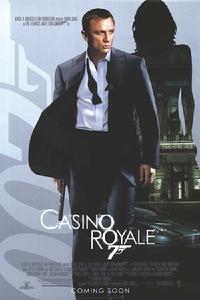
CASINO ROYALE (2006)recommended! Dir: Martin Campbell 4.5 out of 5 stars
Awesome fun! Daniel Craig makes a great new Bond in this "prequel" that details Bond's entry into the secret service and the birth of agent 007. Camp gives way to a bit more realism this time around. Eva Green is to die for, the action fun, the plot intrigue interesting. DAme Judy Dench returns as "M" and the original John Barry score we know and love is back! The opening song by Chris Cornell is amazing. The third act goes a little over the top and the love element a bit too much, but tried in earnest to explain the origins of Bond's ways and how he became so detached and sauve. A great ride.
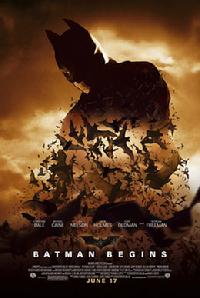
BATMAN BEGINS (2005)recommended! Dir: Christopher Nolan
Pretty darn good. As one critic said "they finally got it right." This installment of the BATMAN franchise goes deep into the roots of the "Dark Knight" tradition of the DC comic. Bruce Wayne is a tormented soul who learns to master his fears and turn fear against "the enemies of justice." The villians are not cartoon characters and there are genuinely complex conflicts and moral concerns at work in the story. There are no winks at the camera as with the other films. Although the finale was a little weak, the film was engaging from start to finsh and refreshingly dis-associated with any of the stylistic treatments the other sequels presented. Most of all, this movie is a good example of what a film can be if it has a decent script that has a solid premise, isn't afraid to beleive in itself and doesn't try to pander to anyone. Well done. Screenplay co-written by David S. Goyer (the BLADE trilogy) and produced by Larry (ESCAPE FROM NEW YORK) Franco. Great score penned by Zimmer AND Howard. Christian Bale contiues to impress with another solid acting performance of yet another in a series of strange and tormented charactes he is so well cast at portraying.
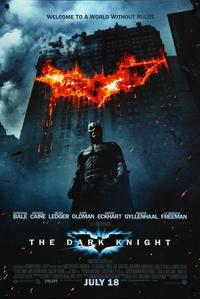
THE DARK KNIGHT (2008)recommended! Dir: Christopher Nolan Outstanding!
Full review coming soon!
THE DA VINCI CODE (2006)recommended! Dir: Ron Howard I liked this movie, it was a fun "Indiana Jones" adventure that referenced real history and mythology in a densely woven mystery that is complete fiction. Ian McKellan was especially notable. The controversy surrounding this film is a whole other essay regarding the general publics' lack of cinema education. Suffice to say, the religious faithful have nothing to fear from this movie. While the story details are provocative, the overall themes they service are actually near and dear to any religious mind. "If you had the truth, would you use it to build up faith or tear it down?" Interestingly, all the characters in the story are doing what they believe to be right in the name of saving mankind's faith, yet they are all opposed to one another. The drama becomes about how far one will go for the sake of right and wrong. Would you step outside of what you believe in order to protect what you believe? The story begs us to consider the fundamentals underlying any system of faith, but more than anything, it's just an entertaining movie with clever plot mechanics and a few car chases. Directed by Ron Howard (CINDERELLA MAN, A BEAUTIFUL MIND, APOLLO 13, RANSOM)
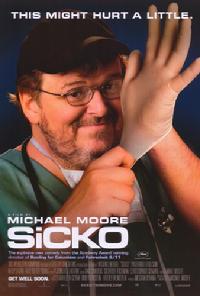
SICKO (2007) Dir: Michael Moore
4 out of 5 stars
Michael Moore is back, this time stirring up controversy over the issue of American health care. Unlike the op-ed piece FAHRENHEIT 9-11, SICKO is more of a return to Moore's compare-and-contrast documentary critique style. By examining American health care and then going to different countries to ask the same questions, Moore underscores the differences between private and universal sponsored health care systems. Although Moore paints a quite black and white difference between the two systems (Europe = good, America = bad) the situation is not quite as simply defined in real-life. Though it would be nice to believe in the utopian dream of Moore's France and England (and even Cuba!) the film serves as more of a food-for-thought device than a final answer. None-the-less, the ongoing question / crisis of American health care remains. With the number one cause of private bankruptcy in the nation going to health care costs, perhaps SICKO will help sustain some much needed discussion on the issue.
AN INCONVENIENT TRUTH (2016) Dir: Davis Guggenheim
3 out of 5 stars
A fun time if you enjoy democrats telling you the world is about to end. If what Al Gore "The most famous Ex-Next-President" is saying is all true, then this movie is an important docu-conference. Otherwise, it's a colossal waste of time. Although tightly made, the problem here is that there is no way to corroborate the subject material for we the general public audience- at least not within the span of the film itself. So who knows- maybe it's all true, maybe it's not. This movie did not make me absolutely-sure-beyond-all-politics kinda "sure." Directed by Davis Guggenheim (TV's: DEADWOOD, THE SHIELD, 24, ALIAS) UPDATE: this film has won Al Gore an OSCAR, an EMMY and a NOBEL PEACE PRIZE.
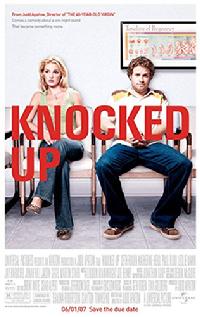
KNOCKED UP (2007) Dir: Judd Apatow
4 out of 5 stars
Funny and also poignant, with a lot of heart. Not the fart-joke comedy you might expect, this is film has some maturity and a decent message. Good performances as well.
HOLLYWOODLAND (2006) Dir: Allen Coulter
4.5 out of 5 stars
I really thought this was an effective drama underscoring the vacuous nature of Hollywood. Not only is the entertainment super-structure of the biz one that promotes illusions in it's product, but the culture surrounding it deceives itself in the same illusory way. Adrien Brody (THE PIANIST) plays a dead-beat dad private-eye on the trail of another evil studio conspiracy, only finding that it is he himself who is spinning the make-believe. Strong performances by both Diane Lane and Ben Affleck (watch for them at Oscar time.) Directed by Allen Coulter (TV's: THE SOPRANOS, SEX IN THE CITY)
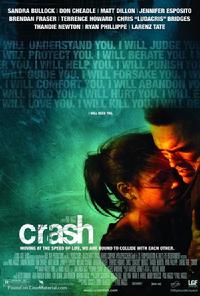
CRASH (2004) Dir: Paul Haggis
CRASH is one of those rarely satisfying films that you "wish someone would make" or you fantasize yourself making because it elaborates small, day-to-day moments of social conflict that might only be passing moments in another narrative. A host of varying characters in Los Angeles experience racial issues over a period of a few days. We are given sort of a fly-on-the-wall view of each character in their own separate worlds. Although, we don't see the same events repeated from different points-of-view, we are given enough colliding parallel stories such that the effect is almost the same. Part Robert Altman (THE PLAYER, SHORT CUTS) part Paul Thomas Anderson (BOOGIE NIGHTS, MAGNOLIA) CRASH edits together isolated moments of social-conflict to weave a portrait of modern urban racial intolerance.
What's perplexing about the success of this film (or at least it's mass acceptance by critics) is the fact that it works on only a thread of dramatic structure and almost no character development. Audiences and reviewers seemed so taken by CRASH's themes and overall affect, that the same voices who would typically trash a project like this, instead exalted it to righteous levels. CRASH is not only significant in it's human themes but also as an example of how fickle the Hollywood establishment can be. I would have expected to have to defend a film like this on it's conceptual merits despite it's dramatic flaws, yet it walked away with the all the awards as the toast of industry. This once again proves that "rules" are meant to be broken and the only element that really matters in the end is if the work moves you or not. I'm really not sure how i feel about this.
I submit that if CRASH had been about another issue besides racism, perhaps a more subtle human issue and not one so politically charged, no one would have cared much for it. I think it has been impossible to separate the political climate of this film with the reality that it's 90 minutes of celluloid.I viewed CRASH on DVD back-to-back with MISSISSIPPI BURNING (my 3rd viewing) and DO THE RIGHT THING (also for the 3rd time) i found both to be much more lasting statements on racism and culture, mostly due to narrative character development. CRASH works more as an experimental statement on racism than as a story. CRASH sort of says "Here's is racism, this is what it is- in all it's irony- no one is safe and everyone is to blame." The solutions are left for us to find.
As i watched CRASH, i couldn't help but be reminded of all the Theater Arts labs and one-act showcases i saw in college. The kind of very dramatic, socio-political plays where acting students reach down in to the depths of their very souls to say- pour coffee or answer the phone. As you watch you think to yourself, "in a few years, after they've grown into their craft, they'll look back and laugh at this." Well, i kinda felt that way about CRASH. It's a great experiment- like a big neon sign alerting us to this huge idea with all the earnest of a student film, but will it's drama have any lasting affect?
Personally, i feel to fully review CRASH would be to also embark on several essays about the role of drama and film as mass-communication. A decade ago, Spike Lee's DO THE RIGHT THING was shut out- now CRASH gets the Oscar. Go figure.
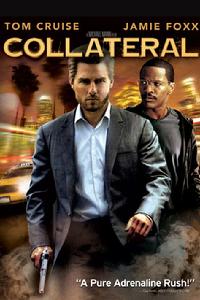
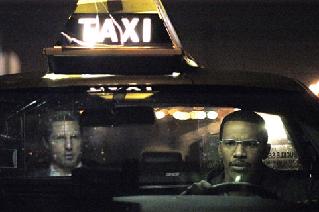
COLLATERAL (2004)recommended! Dir: Michael Mann Michael Mann delivers a successful existentialist moral play reminiscent of Hitchcock's STRANGERS ON A TRAIN. Unassuming cab driver Max (Jamie Foxx) meets his alter-ego in Vincent (Tom Cruise) a cold, calculating hit-man. The two engage in a literal and intellectual battle of ethics, cause-and-effect and the concept of insignificance in an indifferent world. Vincent is the foil that forces Max to realize the denial in his own inner life. By the third act, the two characters become reliant on one another as the reality becomes clearer that they are really two halves of the same whole.
Just as Vincent disconnects from his conscious in order to do what he does, so too does Max, as he disappears into wishful thinking of what he will do "someday" - while staying locked in the paralysis of his day-to-day routine. When Vincent forces Max to face these truths about himself, he purposely wrecks his taxi-cab they are speeding in (to the tune of Audioslave's "Shadow on the Sun") This moment immediately reminded me of Godard's PIERROT LE FOU when, after a conversation comparing the structural conformity of social living to the metaphor of driving a car on the proper side of the road, Jean Paul Belmondo instantly whips the steering wheel and drives his car off the highway and into the ocean. Tossing his life to chance, Max exits his existing universe to enter a new, unknown frontier. He imitates Vincent, down to repeating his dialogue and eventually to picking up a gun himself. At a meeting with Vincent's criminal boss, Max must actually assume Vincent's identity in order to survive. Ironically, by embracing his own inner Vincent, Max is able to integrate his missing parts and succeed in committing to forward action.
At the story's climax, Vincent and Max shoot at each other through closed doors on a moving MTA train. Giving everything over to fate, they blindly empty their guns at each other, through the partial view of the windows on the sliding doors of the passenger car- almost as if facing down their own reflections in a mirror. The one who survives, is of course, the one who has been able to integrate both halves into himself. As he dies (in a poignant and appropriately understated way) Vincent poses one last haunting question to Max: "if a stranger dies on the MTA, does anyone care?"
DOPPLEGANGER IN THE MIRROR
CITY OF LIGHT IN HI-DEF
Shot in hi-def video (not film) the movie has all of Mann's standard visual motifs: city skylines at night, colors reflecting off polished vehicle surfaces and many layers of reflections in glass and buildings. There is even an obvious homage to Hitchcock's REAR WINDOW in one shot. In this film, these visual motifs help to hint at other levels of reality existing at once, not unlike the yin and yang of the two main characters. There is also something powerful in the visual minimalism of LA's skyline and it's lack of visual reference points- which creates a blank canvas for the other motif's to stand out in. Much like all his other films (and similar to the work of Ridley Scott) the film is primarily shot in 50mm or closer, compacting the depth-of-field and making for an intimate and precise feel in an otherwise expansive look space. This is particularly important given that the majority of the film takes place in the confines of an automobile. The few moments that are shot in wide angle seem almost expressionist in contrast and are intelligently used in dramatic moments of tense uncertainty. Following in many of the character themes of his earlier HEAT and THIEF, COLLATERAL succeeds in taking the alter-ego theme into deeper territory and is perhaps Mann's masterpiece on this thematic concern. Worth mentioning is the way in which the films' logic weaves seamlessly without talking down to it's audience and avoids the standard cliches of the action/suspense genre. The film does not glamorize it's characters as we are all-too-used to seeing. This is especially nice coming from the same director who gave us MIAMI VICE the TV series. Cruise and Foxx are both very well cast. Foxx has a quality of vulnerability in his on screen performances that serves his character perfectly here. There is a feeling of bitter-sweet triumph as he wrecks his cab and picks up Vincent's gun that would probably not have worked with a "slicker" portrayal. Cruise is perfectly cast as well as an obsessive and calculating entity, one step ahead of his own insecurities- character traits common to many of Cruise's on screen characters as well as directly reflecting elements not far from his own life.
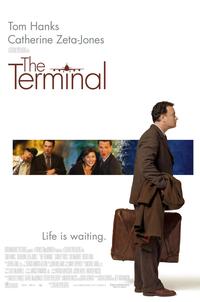
THE TERMINAL (2004) Dir: Steven Spielberg A light-hearted and effective story about the absurdity of modern beaurocracy. Loosely based on a true story, Tom Hanks portrays a man from a fictional former soviet state, who cannot enter America, yet cannot return home and must stay inside JFK airport in New York for nine months. Pleasantly, there are no black & white good guys and bad guys in this story, just people trying to do what they believe is right. The most poignant scene is one of his friends sacrifices his own amnesty in order to help him stay long enough to complete his goal. (in a shot reminiscent the famous image of a lone protestor facing a column of tanks in Tiannenmen Square) He charges like Don Quixote at an arriving airplane armed only with his mop. Summing up the absurdity of the situation, the scene ends with the tiny. harmless man surrounded by a SWAT team with riot gear and machine guns.
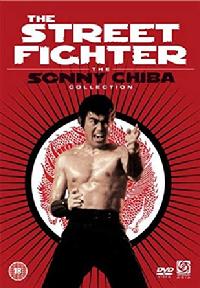
THE STREET FIGHTER (1974) (aka: Gekitotsu Sataujin ken) Dir: Shigehiro Ozawa
I had only seen one Sonny Chiba film prior to this one and it was God-awful, so i didn't understand all the hype. Now i do- this movie was awesome fun! There are many elements about Sonny Chiba and STREETFIGHTER that are unique in the martial-arts film genre. First of all, this is straight up Karate, not Kung-Fu. This isn't the Kung-Fu theater stuff out of Hong Kong Cinema we're all used to making fun of. STREETFIGHTER is a full on sync-sound, well produced Japanese film. The fight choreography is surprisingly realistic and the filmmaking pays a certain reverence to this. Although there are bizarre, absurd moments that are thrown in (like an x-ray close up of a hand breaking a paper-mache skull!) that raise an occasional eyebrow- overall the film works in its story and character as well as intriguing action sequences. The film transfer quality on the DVD was really sharp and well processed in full cinemascope aspect ratio. Pretty good score as well. Most interesting of all was the moral kunundrums surrounding Chiba's character "Terry" a gun-for-hire whose only allegiance is to his old-school fighting style which is becoming increasingly forgotten in the modern world. Tricky questions of loyalty and honor permeate this narrative where seemingly everyone is dis-honest and the only redeeming values are in dis-believing false values.
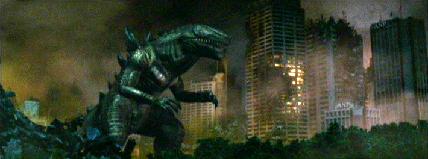
GODZILLA: FINAL WARS (2004) Dir: Ryuhei Kiriyama
I wasn't aware that a film could be this completely awful. DO NOT SEE THIS FILM whatever you do. In fact, erase the thought of it's very existence from your memory. If you can't seem to do that, then smash your head against a wall until it no longer can think- i guarantee it will be a more pleasant experience than viewing this trainwreck. This is the kind of movie that makes you fantasize you could murder the filmmakers and get away with it- but only if the fantasy also includes a magic elixer that brings them back to life so as to murder them over and over again. Seriously, block all of this from your mind. THEN GO OUT AND FIND A WAY TO SEE THE RECENT RE-MASTERED RE-RELEASE OF THE ORIGINAL1954 GODZILLA(Japanese Version) WHICH IS AMAZING! Loosely based on the earlier DESTROY ALL MONSTERS, FINAL WARS tries to say goodbye to the franchise with absurd self-parody rather than with any sense of class. Among the many, many flaws and mis-fires the film offers, the music is seriously bad- complete with electro-rock and an incidental score that seems curiously composed on a kids Casio keyboard. During one of the monster fights, heavy metal music takes over with a track by the band Sum-41. Also, oddly enough, the film co-stars UFC champion and Japan Pro-Wrestler Don Frye as the token gruff American military captain. As much as the movie tries to be a tongue-in-cheek send up of 50 years of the Godzilla legacy- the filmmakers are obviously more interested in making different kinds of action films. The movie references THE MATRIX series- complete with a star that looks suspiciously like Keanu Reeves- THE X-MEN, INDEPENDENCE DAY and STAR WARS among others. There is more adrenalized martial-arts CGI than anything else and we get 20 whole minutes of Godzilla towards the end. The film also looks like it may have been shot in hi-def video, although the special features show some of the behind-the-scenes production and they are definitely using film. All in all, the visual look of the film is strangely horrible.
The editing jumps so much, you give up trying to engage the story by act 2. Perhaps the only moment that borders on cool is when the creature from the American GODZILLA by Roland Emmerich shows up (called "Pretender") and GODZILLA destroys it in a single breath! Toho is winking at the camera here reminding who the real boss is. Sadly, the joke is on them as the Emmerich production was much better than anything they are offering with this film. If all this wasn't bad enough- GODZUKI SHOWS UP!
In recent years, a new crop of filmmakers- ones who grew up on Godzilla films in their youth- have re-energized the franchise with a series of new films and re-makes nick-named "the milennium series." These works have brought back a more vicious Godzilla, more in line with the legacy of the first film. GODZILLA vs BIOLANTE and GODILLA vs MEGAGUIRUS swap out the monsters-doing-karate sillyness for a more philosophical, horror/sci-fi approach. Most noteable is GODZILLA 2000 which showcases clever characters and fun production values without taking itself too seriously. Well, unfortunately, the karate is back. Fans have long held the 70's GODZILLA vs MEGALON (featuring "Jet Jaguar") and GODZILLA vs HEDORAH (aka: Smog Monster) as the all time worst of the franchise. GODZILLA: FINAL WARS trumps them completely. Instead of ending the 50 year legacy with a bang, Toho seems to have ended it with a sigh.
TRANSPORTER 2 (2006) Dir: Louis Leterrier The first TRANSPORTER was a refreshing surprise. The kind of action film that you don't realize is a martial-arts epic until the end because it develops its' character, story and premise slowly and thoughtfully. It isn't until after the film that you realize you just watched a chop-socky flick. Unfortunately, this sequel lacks all of the charm and poise of it's predecessor. Although the set-up in the first act is good, from the very first fight the film establishes itself as absurdly, un-realistic. In the first film, we were willing to go where it was taking us because there was a thread (be it a thin one) of realism perhaps- or at least a sense of wit that didn't treat it's audience as suckers. TRANSPORTER 2 is so wildly ridiculous that we stop paying attention half-way and the final action sequence in act 3 is so over-the-top that it's just insulting. Model-turned-actress Amber Valetta is gorgeous and offers up the best performance in the film. If you must rent the film, turn the sound down, forward through the fights and just watch her.
DEJA VU (2006) Dir: Tony Scott
2 out of 5 stars. Sucked.
FOR YOUR CONSIDERATION (2006) Dir: Christopher Guest (BEST IN SHOW, A MIGHTY WIND, WAITING FOR GUFFMAN, THE BIG PICTURE) 3.5 out of 5 stars
Christopher guest and his usual ensemble cast poke fun at the absurdity of the Hollywood system and it's vanity. Guest is best known as the character Nigel Tufnel from Rob Reiner's classic THIS IS SPINAL TAP. Guest made his directorial debut with the awesome WAITING FOR GUFFMAN which set up his trademark style of oddball, quite pathetic characters searching for fame and glory. While a comedy, there is a dark undercurrent of realism within the film that ends on a very jarring statement about values-gone-lost. A bit short, the film leaves you wanting a bit more. All-in-all, well done and more of a social meditation than Guests' previous A MIGHTY WIND and BEST IN SHOW. Catharine O' Hara is terrific as a has-been actress trying to become "comfortable in her own skin."
THANK YOU FOR SMOKING (2005) Dir: Jason Reitman (JUNO, UP IN THE AIR, YOUNG ADULT)
3 out of 5 stars
Well meaning and funny but kinda forgettable. An edgy marketeer is hired by big tobacco to help feed BS to the public. However, a crisis of conscious throws things off. Some high points include Rob Lowe as a transvestite Hollywood agent and Robert Duvall as the tobacco CEO. Directed by Jason Reitman.
HIDALGO (2004) Dir: Joe Johnston (JURASSIC PARK III, OCTOBER SKY, JUMANJI, THE ROCKETEER) 3 out of 5 stars
A well made and entertaining enough Disney-esque feature about an American (Viggo Mortensen) who enters an Arab-only horse race. Somewhat based on real life events. Everything is happy in the end and everything is nice as the hero wins and the Arabs learn the good values of Western democracy, blah, blah- you know the drill. Omar Sharif co-stars.
PIRATES OF THE CARIBBEAN: DEAD MAN'S CHEST (2006) Dir: Gore Verbinksi
3 out of 5 stars
Big-budget fun! Johnny Depp is curious and weird as before and Keira Knightley is gorgeous. A bit more off-center than it's predecessor but with outstanding special effects (you can see the soon-to-come video game as you are watching.) Not as good as the first but wildly entertaining. Directed by Gore Verbinski (PIRATES OF THE CARIBBEAN: THE CURSE OF THE BLACK PEARL, THE WEATHER MAN, THE RING)
SUPERMAN RETURNS (2006) Dir: Bryan SInger
3 out of 5 stars
Much more like the comic book than the other films. The narrative really goes into the tragic/hero nature of Superman and his burden of saving the world from itself. This is at the heart of most super-hero comics but is often watered down at the movies. Although the moral thread is tight, there is a lot of plot logic that doesn't add up and the story isn't so fetching. Brandon Routh is a dead ringer for a young Christopher Reeve as Clark Kent/Superman Kevin Spacey is well cast as Lex Luthor, but the writing of his part lacks dimension as well as missed opportunities for humor. Kate Bosworth co-stars as Lois Lane. Directed by Bryan Singer (X2, THE USUAL SUSPECTS) The film is nicely dedicated to Christopher Reeve and his wife.
POSEIDON (2006) Dir: Wolfgang Petersen
No real reason to remake this other than updated FX tech. I liked the original film, this one adds nothing and is actually not as good. Amazing production values can't help an empty script. Kurt Russell is solid. There are the beginnings of some character development, but it doesn't follow through. Richard Dreyfus starts to kill himself, but then sees the giant wave coming to overtake the ship and he changes his mind quick! The film was trying to obliquely comment on the nature of heroes i think, but the original did it better. Directed by Wolfgang Petersen (TROY, A PERFECT STORM, DAS BOOT)
LIVE FROM BAGHDAD (2002) Dir: Mick Jackson Nothing wrong with it, but i've already forgotten it. Michael Keaton has some nice internal moments in his portrayal of the CNN producer who delivered the now famous broadcast of the U.S. bombing of Baghdad in the first Gulf War. There are some nice actor portrayals of real-life personalities Peter Arnett, Bernard Shaw and John Holloman as they broadcast live from the El Rashid hotel via dedicated phone line, before it was shut down by Iraqi Ministry of Intelligence. An HBO films production, the film plays very much as a "movie of the week" docudrama. The only reason i watched it because Helena Bonham-Carter co-stars, playing the same sort of bi-polar, chain-smoking, on-the-edge chick she played in FIGHT CLUB. She's so darn adorable, i sat and watched the whole movie.
BEWITCHED (2005) Dir: Nora Ephron
More like "Bewildered" as to how this stinker got green-lighted. This movie should be screened in film schools as an educational tool to elaborate why the Hollywood system fails and what happens when you throw talent and A-list names at a bad idea. It's almost impossible to comprehend how incredibly awful this film is. It's pure, un-adulterated crap. The only positive element of this movie is the fact that it was mercifully short at around 80 minutes- the shortest length a "feature" can be. Nothing about the film was funny and it has the stupidest premise ever. An out-of-work lousy actor (Will Ferrell) gets the lead in TV series re-make of the original Bewitched series from the 70's. He finds Isabelle (Nicole Kidman) in a book-store and hires her for the part of Samantha because she can do the nose-wiggle thing. Turns out, she's a real witch. Ohh-ah, clever. Who the hell came up with this stupidity!? Hollywood industry main-stay Nora Ephron directs this pile of rubbish with as much pizzazz as a dead fish you find washed on the shore. Of the all the films or TV shows to resurrect for the sake of "retro" why Bewitched? Are we that out of ideas?? You can almost detect the complete lack of interest in all parties- from the actors to the music score. Total Hollywood assembly line misfire. Do not ever see this flick.
ANCHORMAN: THE LEGEND OF RON BURGANDY (2004) Dir: Adam McKay
My friend and i started watching this on HBO. It was so dull, slow and not funny that we changed channels after about 15 minutes.